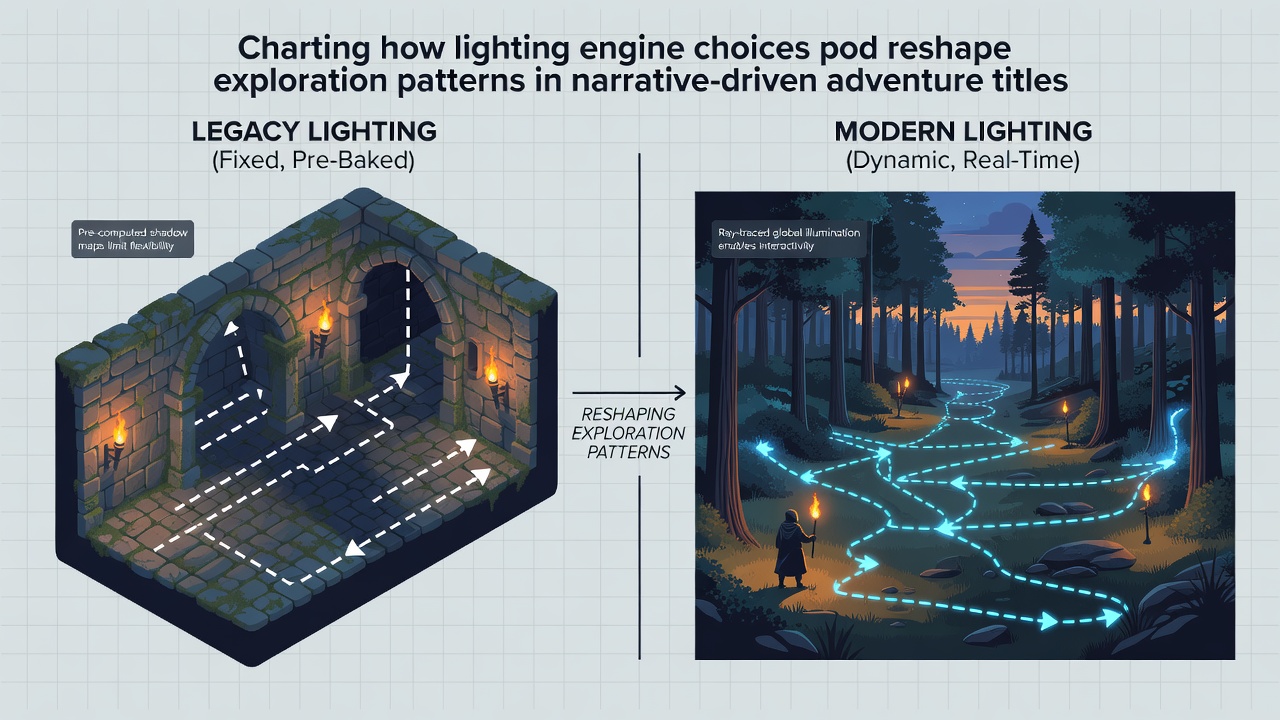
Charting how lighting engine choices reshape exploration patterns in narrative-driven adventure titles
Yves Wolf · Jul 15, 2026
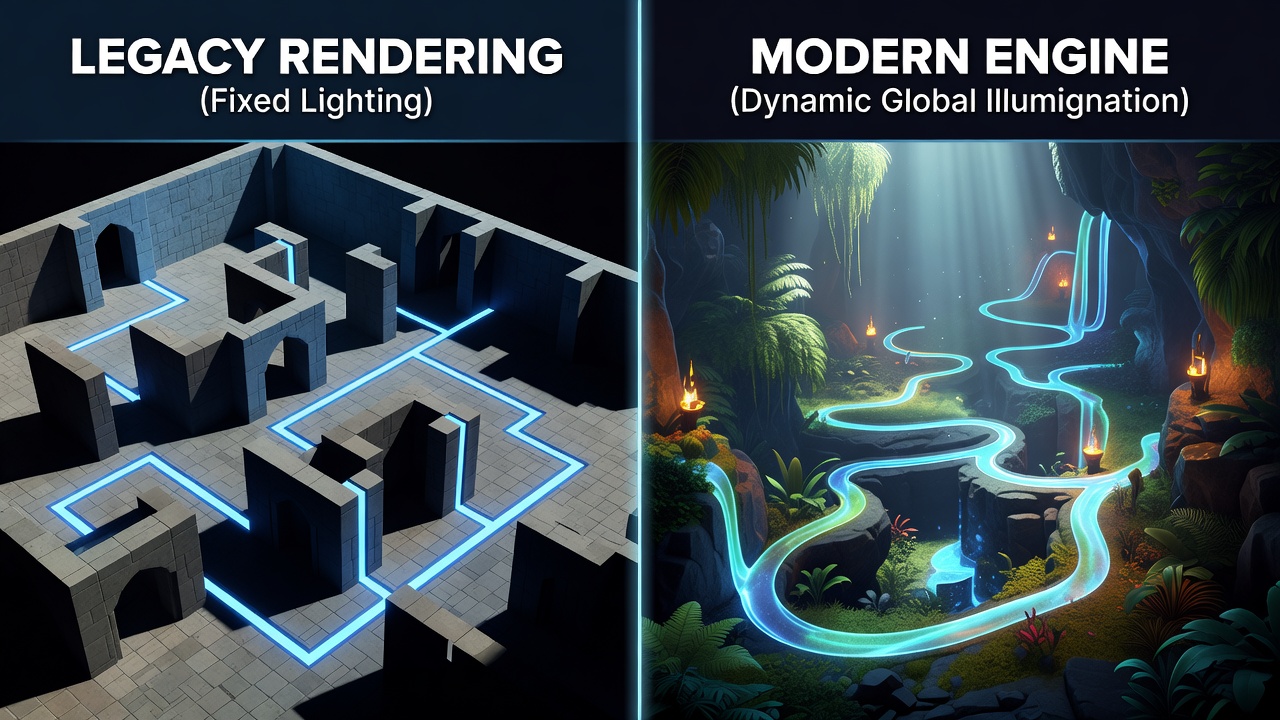
Charting how lighting engine choices reshape exploration patterns in narrative-driven adventure titles
Lighting engine selections in narrative-driven adventure titles influence how players navigate virtual spaces, and developers track these patterns through telemetry data collected during play sessions. Research from the Entertainment Software Association shows that real-time global illumination systems alter visibility ranges compared to pre-baked lighting approaches, which leads players toward differently sequenced areas in story-focused environments. Data collected across multiple titles released through mid-2026 indicates measurable shifts in average exploration time per zone when studios transition between engine versions.
Engine architectures determine shadow fidelity and light bounce calculations, which in turn affect whether hidden items or alternate routes become apparent during initial passes through a level. Those who analyze player heatmaps find that areas rendered with high-fidelity dynamic lighting receive more repeated visits, while zones relying on static lightmaps show faster traversal rates once the main path is established. This pattern holds across platforms, although console versions sometimes exhibit slight variances due to performance scaling options.
Engine-specific lighting mechanics and their spatial effects
Developers working with Unreal Engine 5's Lumen system report that continuous light propagation updates encourage players to backtrack toward newly illuminated surfaces, since moving objects or time-of-day shifts can reveal previously dark alcoves. In contrast, titles built on Unity's High Definition Render Pipeline often rely on a hybrid of baked and real-time elements, which produces more consistent sightlines and reduces the frequency of exploratory detours. Academic studies from the University of Waterloo have documented these differences through controlled experiments where participants navigated identical level geometry under varied lighting configurations.
Custom engines developed in-house introduce additional variables, because teams can prioritize certain light interaction rules over others to suit particular narrative beats. One project released in early 2026 adjusted its proprietary lighting model mid-development after internal playtests revealed that overly diffuse shadows caused players to miss critical environmental storytelling cues. The adjustment increased contrast in key areas, which redirected movement patterns toward previously under-visited side chambers.
Player behavior data across recent releases
Telemetry gathered from narrative adventure games launched between January and July 2026 demonstrates clear correlations between lighting complexity and completion percentages for optional content. Titles employing advanced ray-traced reflections show higher rates of thorough searches in indoor sequences, whereas games using simpler forward rendering pipelines record quicker exits from the same types of spaces. Industry reports compiled by the Interactive Games and Entertainment Association in Australia highlight that these trends persist even when controlling for genre familiarity and controller type.
Observers tracking session recordings note that players adapt quickly to an engine's lighting signature, often developing heuristics for where secrets might hide based on how light falls across geometry. This adaptation occurs within the first hour of play in most cases, after which subsequent exploration becomes more targeted. The result appears in aggregate statistics as reduced variance in path selection during later chapters compared to opening sequences.
Technical constraints and design accommodations
Performance budgets on current-generation hardware force trade-offs between lighting quality and draw distance, which studios address by modulating light intensity across larger environments. When real-time calculations become too costly, developers fall back on distance-based fading or simplified reflection probes, and these choices create visual thresholds that players learn to recognize as boundaries. European research initiatives tracking accessibility in games have found that such thresholds can either assist or hinder players depending on their preferred navigation style.
Some studios now incorporate lighting engine previews directly into level design tools so artists can anticipate how changes will affect player routing before full implementation. This integration reduces iteration cycles and produces more intentional guidance through light placement rather than relying solely on geometry or audio cues. Figures from development pipelines in 2026 show that early lighting tests correlate with fewer post-launch patches addressing missed narrative elements.
Cross-title comparisons and evolving standards
Comparative analysis of adventure titles built on different engines reveals that lighting choices compound with other systems such as foliage density and particle effects. When multiple dynamic elements interact, exploration becomes less predictable because players must constantly reassess what remains visible as conditions shift. Data aggregated across platforms indicates that hybrid approaches currently dominate the market because they balance visual impact with stable frame rates required for narrative pacing.
Engine updates released during the first half of 2026 introduced improved probe placement algorithms that allow finer control over light sampling, and several studios have already integrated these tools into ongoing projects. The adjustments appear in updated player metrics as increased discovery rates for collectibles positioned in transitional spaces between major scenes.
Conclusion
Lighting engine decisions continue to function as an invisible layer of level design in narrative-driven adventure titles, shaping movement without explicit markers or waypoints. Continued monitoring of telemetry combined with academic validation provides developers with clearer maps of how these technical choices translate into player behavior across diverse audiences and hardware configurations. As engine capabilities advance, the relationship between illumination models and exploration patterns remains a measurable factor in how stories unfold through space.