Community Feedback Loops Refining Puzzle Platformer Difficulty Curves Across Hardware Transitions
Morgan Krüger · Jun 24, 2026
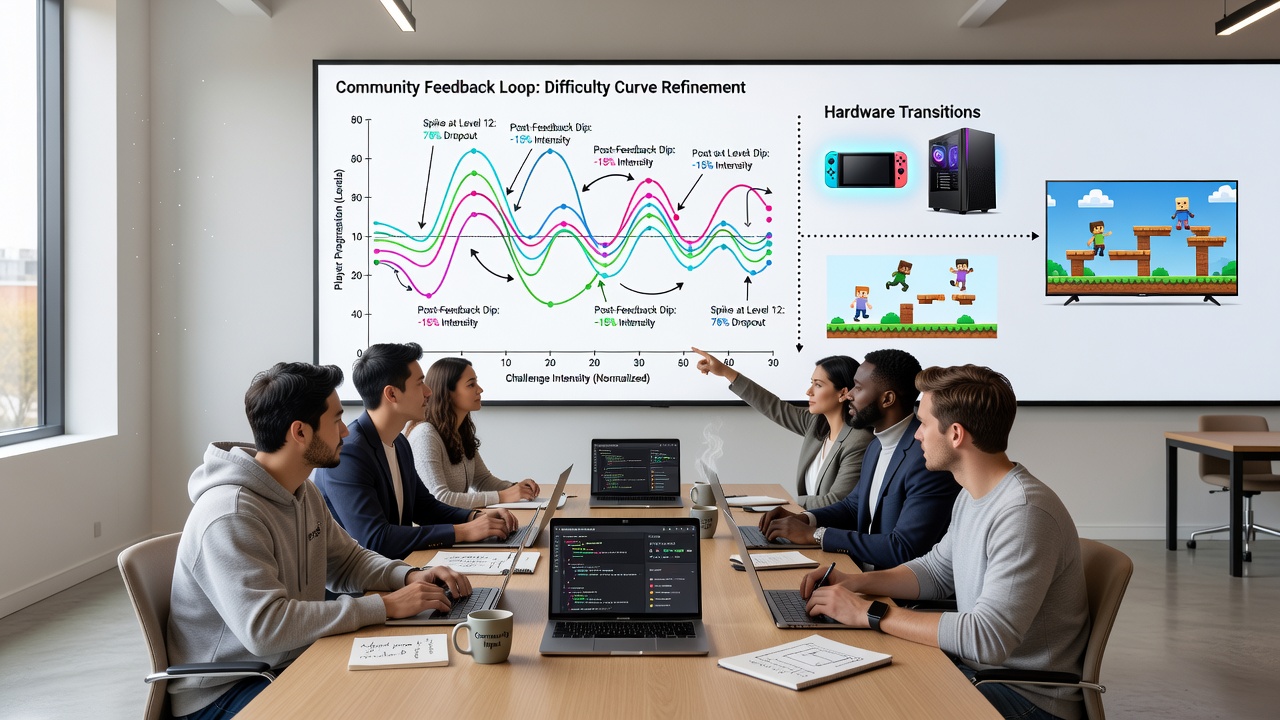
Community Feedback Loops Refining Puzzle Platformer Difficulty Curves Across Hardware Transitions
Developers in the puzzle platformer genre track player progression data across PC, console, and mobile releases to identify where difficulty spikes create friction during hardware shifts, and community input refines those curves through structured feedback channels. Studies from research institutions such as the European Games Research Consortium document how input method differences, including controller precision versus touch screen gestures, alter optimal jump timing and puzzle solution paths.
Hardware transitions introduce variables like frame rate consistency, screen size constraints, and control latency that reshape player interaction patterns. Teams collect telemetry on completion rates for specific levels, then cross-reference those figures with forum discussions and survey responses gathered in the weeks following each port. This process reveals mismatches, such as sections that feel intuitive on a high-refresh-rate monitor yet demand repeated attempts on handheld devices with smaller displays.
Data Collection Methods in Multi-Platform Releases
Analytics platforms aggregate session logs from millions of playthroughs while developers monitor community hubs for recurring complaints about particular mechanics. In June 2026 reports from the International Game Developers Association highlighted a 23 percent increase in cross-platform puzzle platformer launches compared with the prior year, each accompanied by iterative patches informed by aggregated user data. Observers note that early console builds often expose issues with analog stick dead zones that mobile testers never encounter, prompting targeted adjustments before wider distribution.
Survey instruments distributed through official channels ask players to rate segment difficulty on standardized scales, and those results feed into spreadsheet models that predict failure points under new hardware conditions. One studio working on a long-running series discovered that a timing-based puzzle requiring sub-200-millisecond reactions succeeded at 68 percent on PC yet dropped to 31 percent on a major console port, leading to an optional assist mode calibrated through subsequent community polls.
Adjusting Curves Based on Input and Performance Variations
Difficulty curves in puzzle platformers rely on sequenced challenges that escalate cognitive and motor demands, yet hardware differences disrupt the intended progression. Mobile versions frequently compress visual cues due to resolution limits, so designers lengthen reaction windows after feedback indicates repeated misreads of environmental signals. Console iterations sometimes introduce vibration feedback that alters player rhythm, requiring recalibration of enemy patrol speeds or platform spacing to restore intended tension levels.
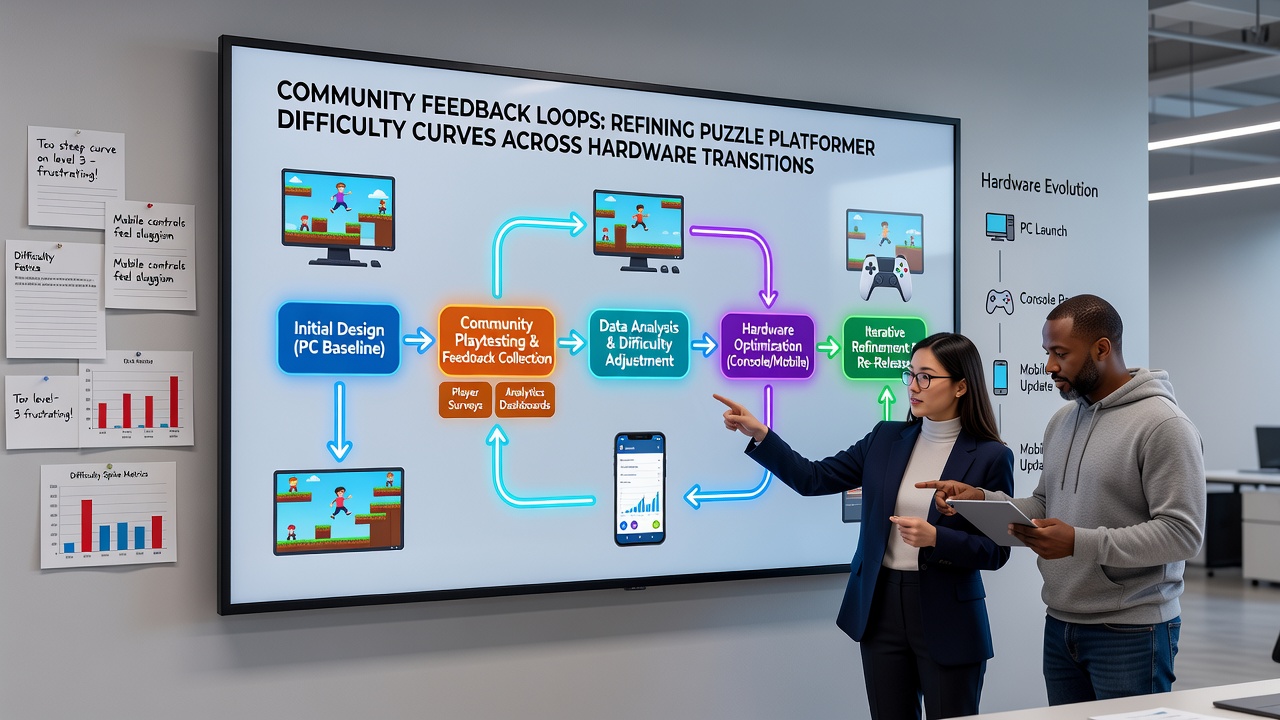
Researchers at the University of Melbourne's Digital Play Lab published findings in early 2026 showing that feedback loops reduce average player drop-off by 14 percent when applied within the first month of a hardware transition. Their dataset covered 47 titles and demonstrated stronger retention when developers shared proposed changes publicly before implementation, allowing further refinement based on additional comments.
Case Examples from Recent Transitions
Teams handling legacy titles often face legacy code constraints that limit how finely difficulty parameters can be tuned across platforms. A notable example involved a 2018 mobile original expanded to current-generation consoles in 2025, where community reports flagged an underwater sequence as disproportionately punishing under controller input. Subsequent patches introduced variable current speeds tied to detected hardware, and completion metrics improved measurably within two weeks of release.
Another project tracked heatmaps of death locations across PC and Switch versions, revealing clusters around a precision wall-jump sequence that performed differently under docked versus handheld modes. Developers responded by adding a toggle for simplified collision detection, informed directly by player-submitted video clips and written accounts shared on dedicated subforums.
Long-Term Effects on Genre Evolution
Repeated cycles of feedback and adjustment create cumulative knowledge bases that studios apply to future projects. Data repositories maintained by industry groups catalog effective mitigation strategies for common transition pitfalls, such as scaling puzzle complexity when moving from high-precision mice to capacitive touchscreens. These resources show measurable convergence in design practices, with newer releases exhibiting narrower variance in completion rates across supported hardware from day one.
Academic analyses continue to examine how these loops influence broader accessibility considerations, particularly for players with motor impairments who benefit from hardware-specific calibration options. Figures compiled through collaborative developer networks indicate that titles incorporating iterative community input release an average of 3.2 post-launch updates focused on difficulty within the first six months, compared with 1.7 updates for titles relying solely on internal testing.
Conclusion
Community feedback mechanisms integrated with hardware transition planning enable puzzle platformer developers to maintain intended challenge progressions despite variations in control schemes and performance characteristics. Ongoing data exchange between players and studios supports incremental refinements that align difficulty curves more closely with diverse player contexts, and continued documentation of these practices contributes to standardized approaches across the genre.