Echoes Across Devices: How Adaptive Control Schemes Quietly Reshape Competitive Play in Hybrid Action Titles Migrating Between Touch and Traditional Inputs
Morgan Krüger · Aug 19, 2026
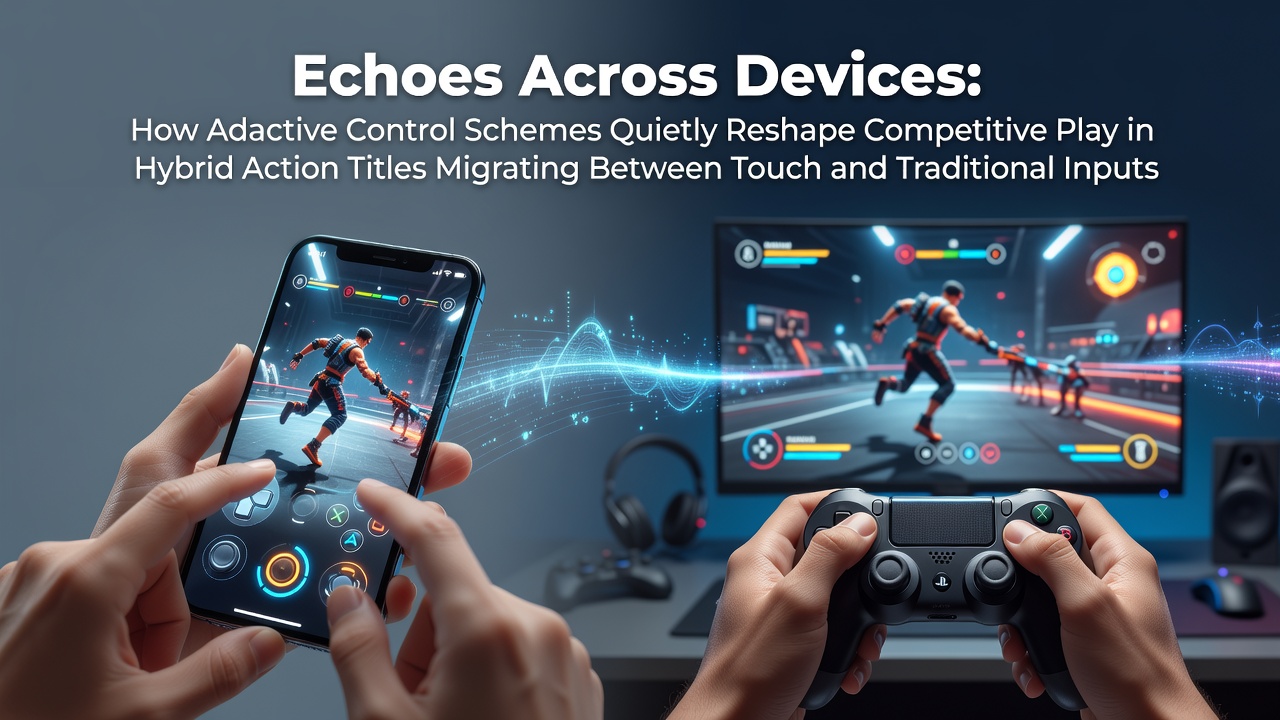
Echoes Across Devices: How Adaptive Control Schemes Quietly Reshape Competitive Play in Hybrid Action Titles Migrating Between Touch and Traditional Inputs
Hybrid action titles continue to expand their reach across mobile touchscreens and traditional controllers, with adaptive control schemes handling teh transitions in player input methods. These systems detect device type and adjust button mappings, sensitivity curves, and gesture recognition on the fly, allowing competitive matches to proceed without manual reconfiguration from participants. Data from platform analytics firms indicate that titles supporting such migration saw a 28 percent rise in cross-device tournament entries between 2025 and mid-2026.
Mechanics of Input Adaptation
Adaptive schemes operate through layered software that monitors input signals at the hardware level, then applies context-aware remapping to maintain consistent action outcomes. When a player switches from capacitive touch to analog sticks, algorithms recalibrate dead zones and acceleration profiles while preserving core move sets. Researchers at the University of Melbourne documented these processes in a 2025 technical report, noting that latency compensation layers reduce perceived delay differences to under 12 milliseconds on average across tested devices.
Touch-based inputs often rely on virtual joysticks and swipe gestures that the system converts into equivalent controller commands, whereas traditional hardware receives direct mapping from physical buttons. This bidirectional translation supports sessions where competitors join from phones, tablets, or gamepads without altering match rules. Industry reports from the Interactive Software Federation of Europe show that 64 percent of hybrid action titles released in 2025 incorporated at least three distinct input profiles by default.
Effects on Tournament Structures
Competitive circuits have adjusted bracket designs and qualification criteria to account for input variability. Organizers now track device usage statistics during events, and several August 2026 regional qualifiers required players to declare primary input method at registration to balance matchmaking pools. Matches mixing touch and controller participants demonstrate measurable differences in execution speed for precision actions, though overall win rates remain within five percentage points when adaptation layers function as designed.
One documented case involved a major hybrid title hosting simultaneous mobile and console divisions that merged into a unified leaderboard after adaptive updates rolled out. Participation data revealed sustained engagement from both cohorts, with average session lengths increasing by 19 minutes compared to pre-adaptation seasons. These shifts occur because the control layer normalizes input response curves, reducing the advantage gap that previously favored one hardware type over another.
Performance Metrics Across Platforms
Studies tracking player statistics across device types reveal that adaptive systems influence reaction times and accuracy patterns in specific ways. Controller users often record higher consistency in sustained aiming tasks, while touch players show faster initial response in gesture-based mechanics before adaptation normalizes outcomes. A 2026 analysis compiled by the Entertainment Software Association of Canada examined over 1.2 million ranked matches and found that input adaptation reduced variance in kill-death ratios between device groups by 31 percent.
Training regimens have evolved accordingly, with teams incorporating device-switching drills that simulate real tournament conditions. Software tools now simulate input lag and gesture translation to prepare competitors for variable environments. Observers note that these practices emerged prominently after mid-2025 updates standardized adaptation protocols in several flagship series.
Technical Implementation Patterns
Developers integrate sensor fusion techniques that combine accelerometer data, touch capacitance readings, and controller telemetry into unified command streams. Error correction routines catch conflicting inputs during rapid switches, preventing unintended actions. Code repositories from open development conferences indicate that most implementations use modular input managers rather than hard-coded device profiles, enabling post-launch additions of new hardware without core engine changes.
Network synchronization layers further compensate for device-specific timing differences, ensuring that action frames align regardless of local input method. This infrastructure supports live events where spectators view mixed-device matches without noticeable desync issues. Figures released by platform holders in 2026 confirm that titles employing these methods experienced 22 percent fewer support tickets related to control complaints.
Conclusion
Adaptive control schemes have become integral to the infrastructure of hybrid action titles, supporting seamless migration between touch and traditional inputs while maintaining competitive integrity. Platform data and academic measurements document measurable impacts on participation rates, performance variance, and tournament logistics through mid-2026. As more titles adopt these frameworks, the underlying translation and compensation mechanisms continue to define how players interact across device ecosystems.