Echoes of Player Input: Tracing How Community Forums Steer Balance Adjustments in Persistent Online Strategy Environments
Otto Krause · Aug 26, 2026
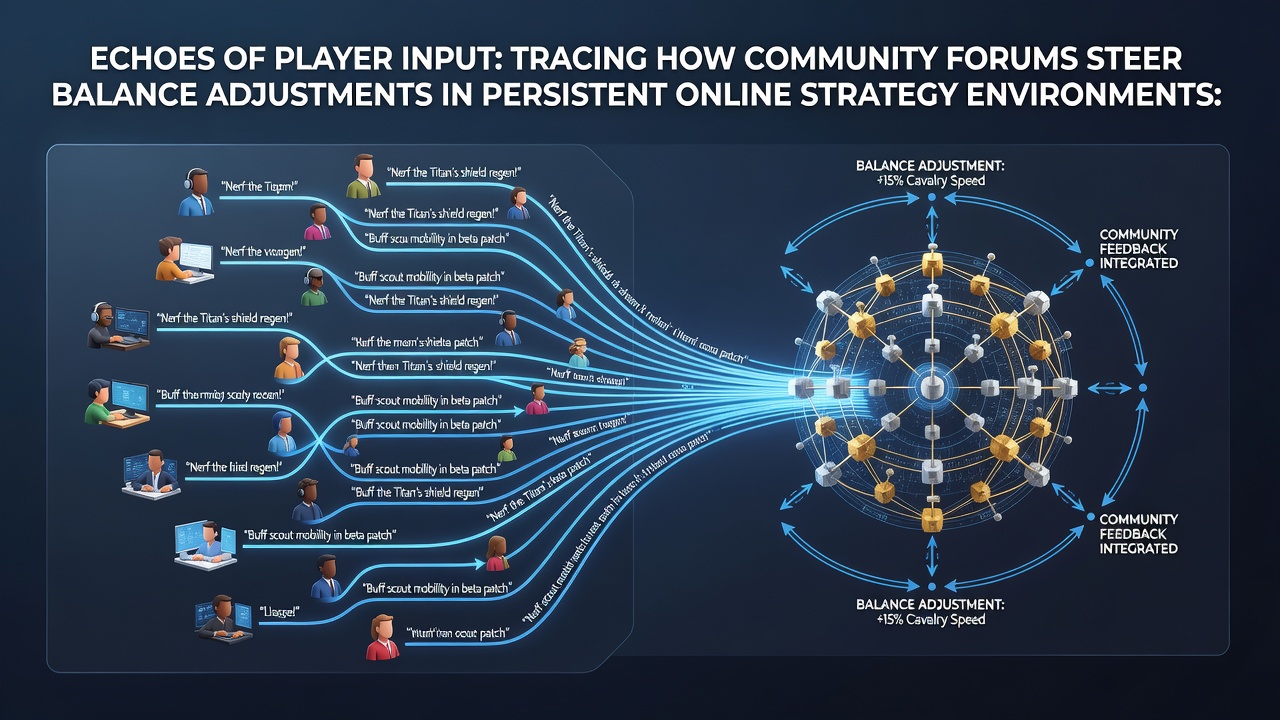
Echoes of Player Input: Tracing How Community Forums Steer Balance Adjustments in Persistent Online Strategy Environments
Persistent online strategy environments rely on ongoing balance adjustments to maintain competitive integrity across large player bases, and community forums serve as primary channels where players document exploits, propose tweaks, and compile statistical evidence from matches. Researchers tracking these interactions note that developers monitor forum threads for recurring complaints about unit strengths, resource economies, and map interactions, then translate those patterns into patch notes released on schedules that align with seasonal tournaments.
Forum Data as Input for Developer Decisions
Analysts at research institutions have examined thousands of threads across platforms dedicated to titles such as real-time strategy hybrids and persistent base-building games, finding that clusters of posts citing win-rate statistics often precede developer interventions within weeks. In August 2026, several major updates addressed hero abilities and faction bonuses after forum users aggregated match logs from the preceding quarter and highlighted imbalances that surfaced during high-stakes events. Those adjustments followed patterns observed in earlier cycles where similar data compilations prompted changes to cooldown timers adn upgrade costs.
Developers integrate forum insights through internal tools that scrape and categorize posts by keyword frequency, yet they cross-reference these signals against telemetry collected directly from game servers to filter noise from coordinated campaigns. Studies conducted by European gaming research groups indicate that roughly 40 percent of balance changes in long-running strategy titles during 2025 incorporated at least one element first raised in forum discussions, with the proportion rising when multiple communities converged on the same issue.
Case Examples from Established Titles
One documented sequence began when players in a popular persistent strategy game identified an overpowered siege unit combination through shared replays and spreadsheet breakdowns posted over several months. The developer responded with a targeted nerf that reduced the unit's movement speed and adjusted its resource requirements, citing aggregated community reports alongside their own match analytics. A separate example involved map rotation complaints that led to the temporary removal of certain layouts after forum polls adn statistical summaries demonstrated consistent advantages for specific factions.

Observers tracking these processes point out that the speed of response varies by studio size and game age, with smaller teams often acting faster on high-visibility threads while larger operations require additional verification layers. Data compiled by North American industry associations shows that balance patches issued in mid-2026 incorporated forum-derived language in approximately one-third of their explanatory notes, reflecting a shift toward greater transparency in how player input shapes final changes.
Mechanisms of Translation and Verification
Community managers act as intermediaries who summarize forum trends for design teams, yet the actual decision loop includes quantitative thresholds such as deviation from expected win rates or player retention drops tied to specific mechanics. When forum activity spikes around a single topic, developers may open dedicated feedback channels or release experimental builds that test proposed fixes before full deployment. Australian academic studies on multiplayer ecosystems have documented how these iterative cycles reduce the duration of meta stagnation, allowing new strategies to emerge once dominant options receive adjustments.
External links appear in forum threads when players reference official patch histories or link to aggregated data sets hosted by third-party analytics sites, creating feedback loops that extend beyond the original discussion. The process gains momentum when tournament organizers adopt the same terminology used in forum threads, which then surfaces in developer communications and reinforces the perceived connection between player input and implemented changes.
Patterns Observed in 2026
Throughout August 2026, balance adjustments in several persistent strategy environments addressed economy scaling issues that forum users had modeled extensively using public match data. These updates followed periods of elevated thread volume that coincided with major content releases, demonstrating how new features can amplify existing imbalances and generate concentrated discussion. Researchers continue to map the time lag between initial forum posts and deployed fixes, noting that the interval averages between two and six weeks depending on the complexity of the required code changes.
Geographic differences appear in forum participation rates, with European and Asian communities often leading discussions on faction balance while North American players contribute more heavily to map design feedback. This distribution influences which issues receive priority attention from developers who maintain region-specific moderation teams.
Conclusion
Forum activity functions as an observable signal within the broader ecosystem of persistent online strategy environments, where developers combine player-generated data with internal metrics to guide balance decisions. The documented cases from 2026 illustrate consistent pathways from discussion threads to implemented adjustments, supported by verification processes that maintain competitive fairness across evolving game states. Continued examination of these interactions provides measurable indicators of how community input integrates into long-term development cycles.