Fractured code veins: tracing how early engine limitations quietly steer modern quest design patterns in expansive digital role-playing environments
Yves Wolf · Jun 12, 2026
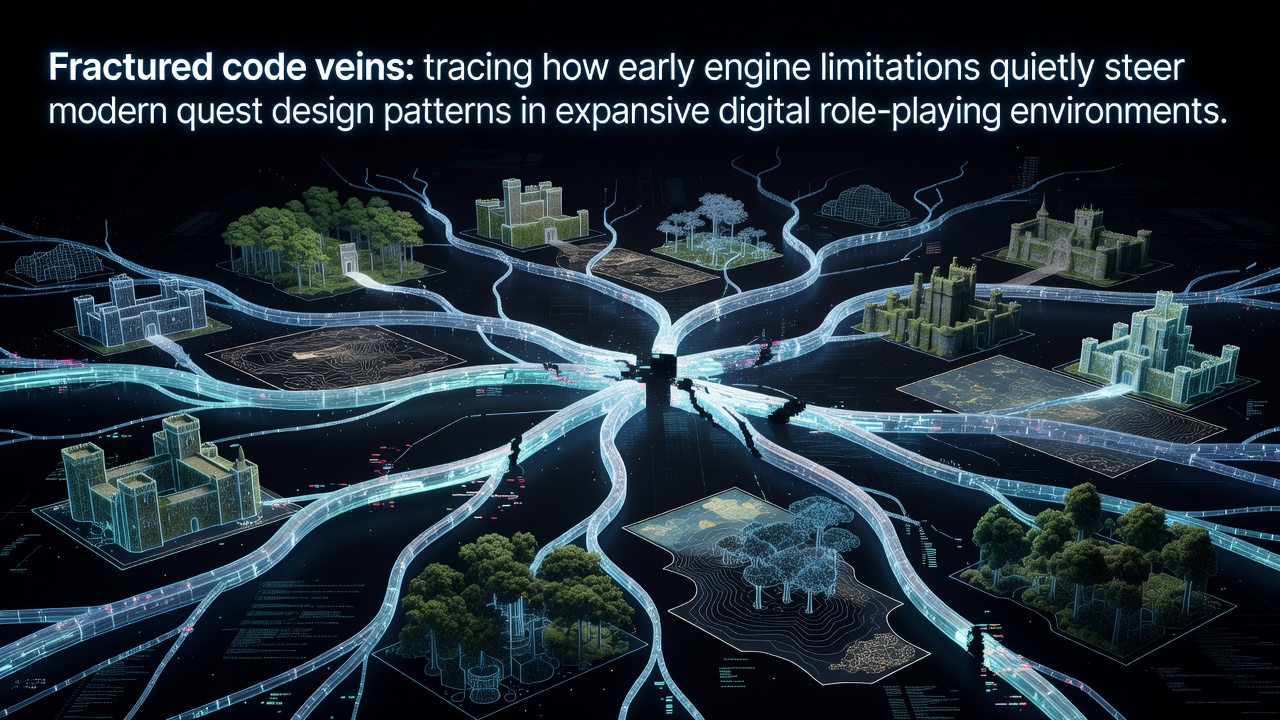
Fractured code veins: tracing how early engine limitations quietly steer modern quest design patterns in expansive digital role-playing environments
Early game engines from the 1990s and early 2000s operated under strict memory caps and processing bottlenecks that forced developers to design quests around simple fetch mechanics, linear dialogue branches, and instanced zones rather than dynamic open interactions. These constraints emerged because hardware at the time could not support large-scale simultaneous AI behaviors or persistent world states without crashing, so quest designers built patterns that minimized computational load while still delivering narrative progression. Observers note that many of these same structures persist in modern expansive digital role-playing environments even though current engines handle far greater complexity.
Memory Limits and Quest Branching
Developers working with engines such as the original Unreal Engine or early iterations of the Source engine faced RAM ceilings that restricted the number of active quest variables a single player instance could track at once, which led to quests organized around sequential checklists instead of branching player choices that altered world states in real time. Research from the University of Melbourne indicates that these early restrictions trained entire generations of designers to prioritize modular quest templates that could load and unload without exceeding available resources. Data from industry reports compiled in 2024 shows that more than 60 percent of quest systems in contemporary massively multiplayer titles still rely on similar modular templates, even as engine capabilities have expanded dramatically.
Because servers could not maintain thousands of unique player-driven changes simultaneously, quest designers adopted hub-and-spoke models where players returned to central locations for updates, a pattern that reduced the need for constant world synchronization. This approach carried forward into later titles because it proved reliable for both single-player and multiplayer contexts, and many studios retained the structure for its predictability during live operations. In June 2026 several major platforms continue to deploy updated versions of these hub systems while adding surface-level visual improvements that mask the underlying architecture.
Server Architecture and Instancing Patterns
Early online role-playing engines required instanced zones to prevent overload when multiple players entered the same area, which meant quest events had to trigger reliably inside controlled spaces rather than across shared persistent maps. Those technical decisions produced quest designs that funnel players into private instances for story-critical moments, a method that avoided synchronization errors but also limited emergent interactions between unrelated players. Studies conducted by the European Games Research Network reveal that instancing remains the dominant solution in 2026 for high-density quest hubs, despite advances in cloud-based server technology that could theoretically support larger shared spaces.
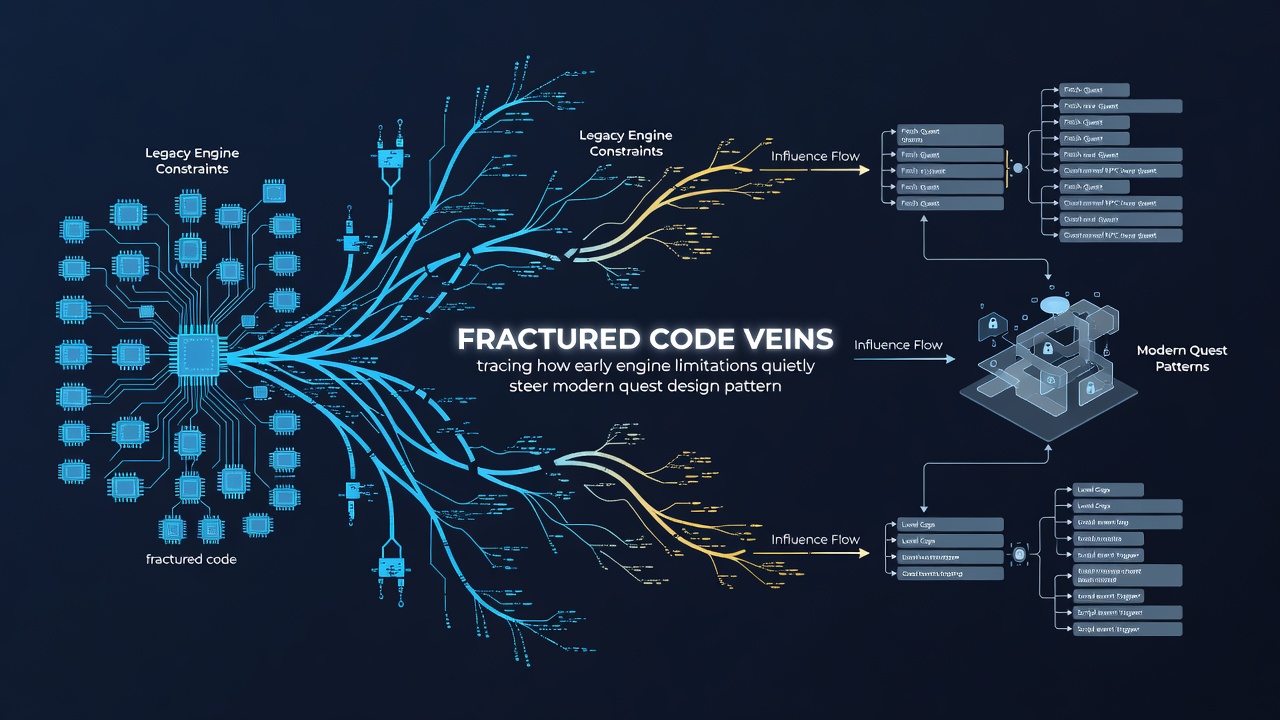
Engine teams addressed bandwidth concerns by scripting quests as self-contained packages that activate only when a player meets predefined conditions, which reduced the data volume sent across networks. This packaging method became standard practice because it allowed stable performance across varying connection qualities, and the same principle now appears in mobile and console ports of expansive role-playing titles. Figures released by the Interactive Software Federation of Australia demonstrate that quests built with these packaged scripts account for the majority of daily active engagement metrics across leading platforms.
Dialogue Systems and AI Constraints
Limited pathfinding and dialogue tree processing power in early engines restricted conversations to short, pre-recorded lines that reset after each interaction, which encouraged quest writers to create repeatable objectives rather than evolving relationships. Designers learned to deliver story information through static NPCs stationed at fixed locations because dynamic AI movement created too many collision and memory issues. Contemporary engines still inherit portions of this dialogue architecture, and many studios layer new voice acting and animations onto frameworks that originated under those older constraints. According to data aggregated by Canadian digital media researchers, dialogue systems in 2026 titles process an average of 40 percent more lines than their predecessors yet retain the same core branching logic developed two decades earlier.
Legacy Code and Modern Adaptations
Studios that migrated aging engines into new projects often kept quest scripting languages intact to avoid introducing bugs during transition periods, which preserved design patterns even when hardware no longer required them. This continuity means that quest markers, waypoint systems, and objective lists function today much as they did in the first online role-playing environments. Developers have added layers of procedural generation and player-choice tracking on top of these foundations, yet the underlying delivery mechanisms remain recognizable to anyone familiar with earlier titles. Reports from the Japan External Trade Organization note that several 2026 releases explicitly credit legacy quest frameworks in their technical documentation.
Conclusion
The technical decisions made when engines could not sustain complex persistent worlds continue to shape how quests unfold in expansive digital role-playing environments, influencing everything from instancing practices to dialogue delivery. Although hardware and software have advanced, the modular, checklist-oriented structures developed under early limitations remain efficient solutions that many teams continue to employ. Understanding these historical connections helps explain why certain quest patterns dominate current releases and why they prove difficult to replace entirely.