Threading the Needle: How Precision Input Mapping Evolves Across Generations of Fighting Game Controllers
Yves Wolf · Jun 26, 2026
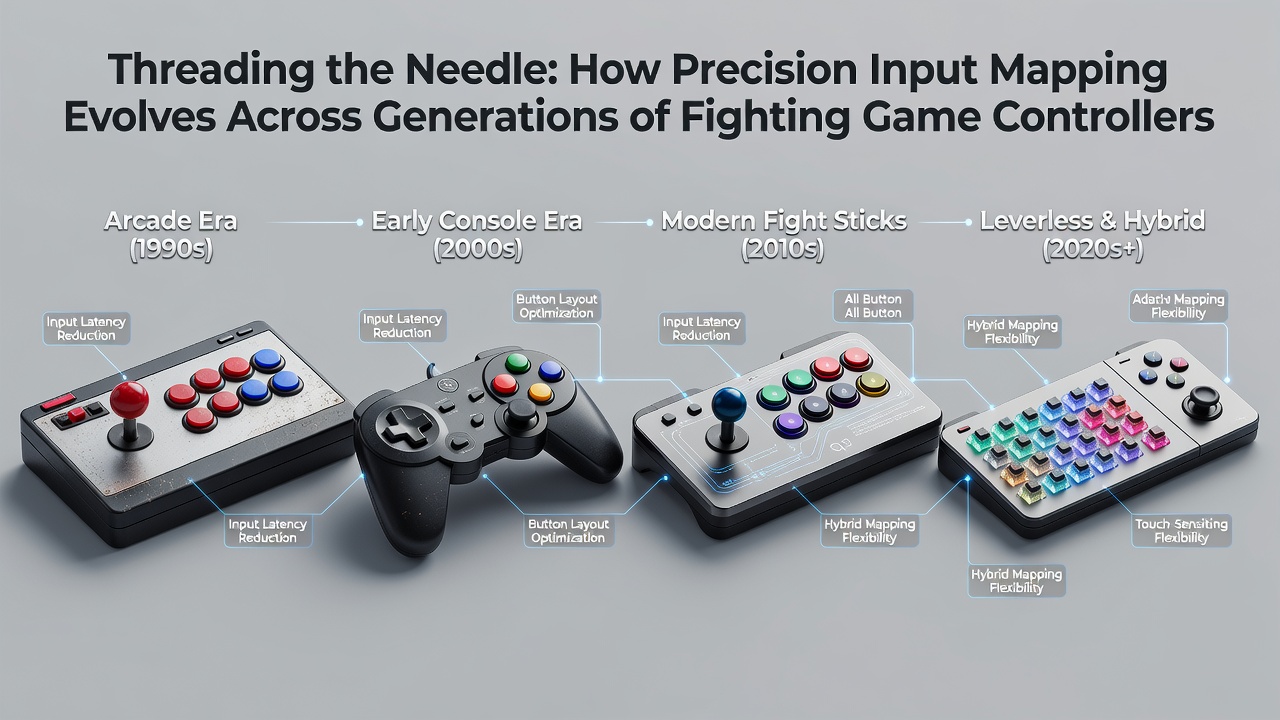
Threading the Needle: How Precision Input Mapping Evolves Across Generations of Fighting Game Controllers
Precision input mapping in fighting game controllers has shifted through distinct hardware generations since the 1980s, with each phase introducing tighter tolerances for directional inputs and button timing. Arcade cabinets established the baseline through eight-way joysticks paired with six-button layouts, where mechanical switches registered presses at fixed intervals of roughly 16 milliseconds. Data from early tournament logs shows that players adapted to these constraints by developing muscle memory around lever throw distances and gate shapes.
Arcade Foundations and Initial Console Adaptations
Manufacturers like Sanwa and Seimitsu refined lever components during the 1990s, reducing debounce times and standardizing microswitch resistance to 50-60 grams. Console ports arrived through devices such as the Sega Saturn's Virtua Stick and Sony's original PlayStation controller, which translated eight-way gates into digital D-pads with four cardinal contacts. Engineers mapped these contacts to the same directional registers used in arcade PCBs, yet the smaller form factor introduced new variance in finger placement. Researchers at the University of Tokyo documented how D-pad edge detection created occasional diagonal misreads during rapid motions, prompting firmware updates in later revisions.
Third-party pads from Hori and Mad Catz incorporated larger buttons and extended levers to bridge the gap, while internal wiring diagrams reveal direct parallels to JAMMA harness standards. Tournament circuits in North America and Japan tracked input consistency through frame-by-frame analysis, revealing that mechanical bounce accounted for roughly 3 percent of invalid commands in recorded matches from 1997 onward.
Digital Refinements in the 2000s and 2010s
The PlayStation 2 and Xbox eras introduced analog stick options alongside digital pads, yet most competitive setups retained eight-way gates because analog resolution exceeded the 8-bit directional registers required by most fighting engines. Firmware patches from console manufacturers addressed SOCD (simultaneous opposite cardinal directions) conflicts by enforcing last-input priority, a rule codified in many titles after 2005. European gaming industry reports from Interactive Software Federation of Europe note that controller sales for fighting genres grew steadily as hitbox-style leverless designs entered the market around 2012.
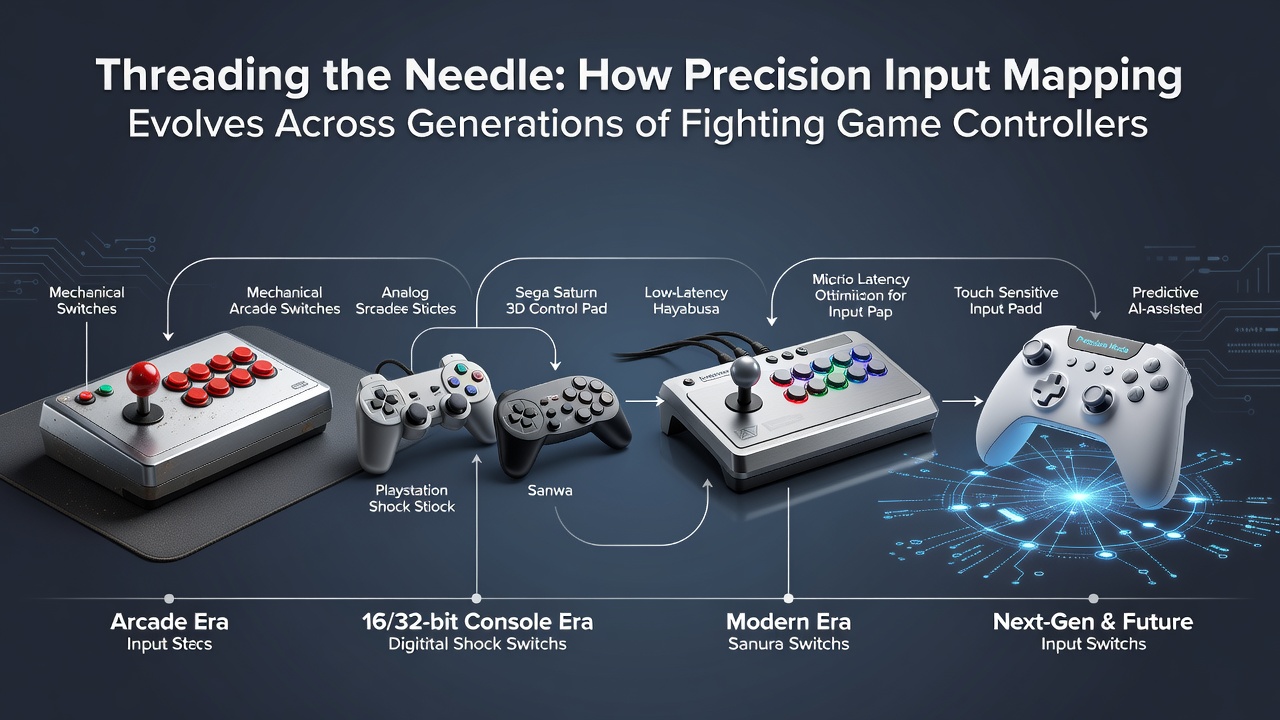
These leverless boards replaced physical levers with four directional buttons, mapping each press directly to cardinal signals and eliminating throw distance entirely. Custom PCBs allowed users to program SOCD cleaning modes through onboard microcontrollers, cutting input latency to under 1 millisecond in lab tests conducted by independent hardware reviewers. Adoption accelerated in major circuits after 2018, with frame data logs from events showing reduced instances of unintended neutral states during cross-up maneuvers.
Current Developments Through Mid-2026
By June 2026, wireless modules with sub-3-millisecond polling rates appear in several commercial leverless models, while firmware updates incorporate per-button debounce calibration adjustable via companion apps. Industry groups such as the Entertainment Software Association have tracked hardware accessory shipments, noting that custom controller kits now represent a measurable share of accessory revenue in the fighting game segment. Academic papers from institutions in Canada have examined how these mappings affect reaction windows, with data indicating that button-to-signal translation remains the dominant factor in high-level play consistency across platforms.
Engine updates in current titles enforce standardized input buffers of 1-3 frames, compelling controller manufacturers to align their polling cycles accordingly. Observers at recent circuits report that players calibrate individual devices for specific games, adjusting actuation thresholds on optical switches or hall-effect sensors to match character-specific timing requirements.
Conclusion
Input mapping precision continues to advance through iterative hardware and firmware changes that address mechanical variance and digital signal conflicts. Each generation builds on prior standards while introducing new calibration options, maintaining compatibility with legacy titles through configurable profiles. Tournament data and hardware specifications document these shifts without altering core gameplay rules established decades earlier.